
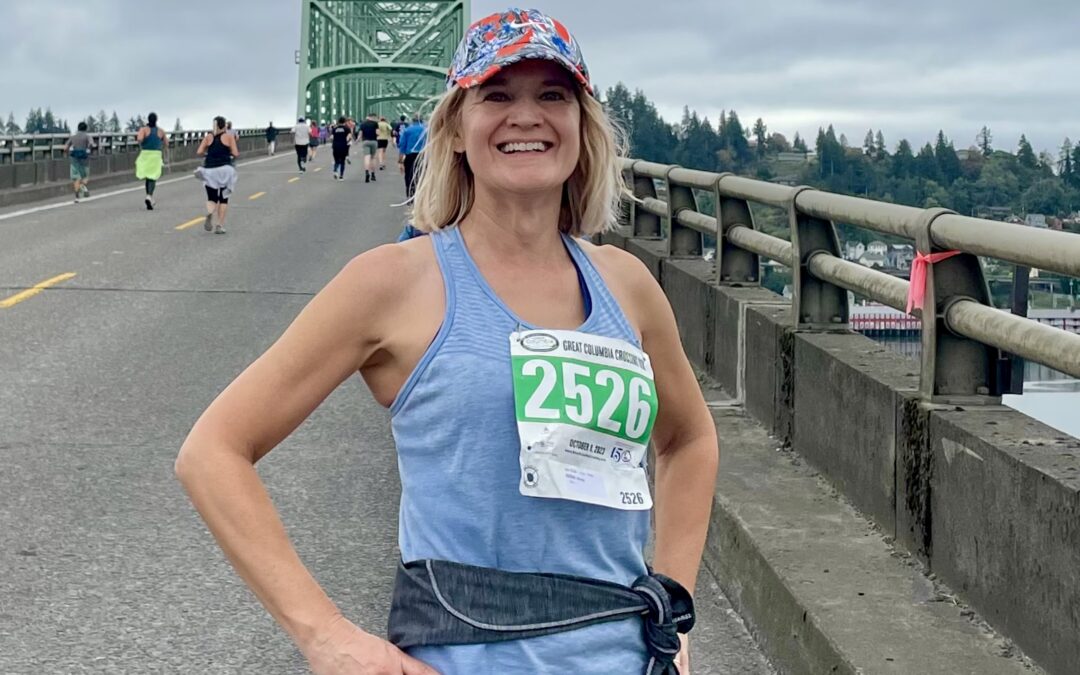
Originally published in Under the Gum Tree, Winter 2024 (Issue 50).
It was losing my girly parts—outsides and insides—to cancer that threw me into early menopause. Now, pessimism, moodiness invades my brain. So, I run. I run from my anger. I run to clear my head—I hate the bitterness, and I hate running, but I can’t stop.
I blame-thank my husband for my running addiction. In my late twenties, I complained to him that my fat pants didn’t fit. Matt, an avid runner, suggested I try running, “It’s healthy and will get you in shape.”
“Me, run?” I said with a laugh. I was a high school cheerleader in the 80s, when it was about the skirt instead of basket tosses. Perspiring wasn’t anything I had ever aspired to do.
Matt volunteered to run with me to get me started. He sang “jodies,” military slang for cadence calls, to take my mind off the physical strain. My job was to respond by repeating the exact phrase. Instead, I shouted back “colorful” words in the same rhythm.
“F-15 roaring down the strip.”
“F-I hate running. Fuck. It hurts.”
“Air Force Jockey on a one-way trip.”
“Stupid steep hill. My lungs burn like hell.”
He didn’t react to my whining, just adapted to my “relaxed” pace—pace as in a-gray-haired-fashionista-holding-a-cane and hustling to a salon appointment moved faster than me. But I stuck it out. We ran together five days a week, and by the end of the month my muscles grew accustomed to the flex and extend motion, and my lungs accommodated deeper and more efficient breath, so I started swearing less. Plus, my jeans fit again.
To acknowledge my newfound prowess, we ran a 3K race. And a year later, on my own, I completed a half-marathon. The satisfaction and elation of finishing those races has stayed with me. I tap into the memory of stepping over the finish line when I need to remind myself that I can do hard things.
On this morning I need reminding. Angst bubbles, trapped in my gut for no reason. Because I’ve been running now for over twenty years, I know exercise will help release tension, but I don’t want to do it. I never want to start a run. “Don’t make me do it” I yell. And Matt kindly ignores my plea. He knows it’s my rallying cry. Running shoes on but no headphones—music buzzing stifles my thoughts—I exit my house and jog onto the streets of West Linn, a suburb of Portland, Oregon.
The minute I leave, my lungs suck in and cough out the pollinated air. The aroma of lilacs and dewy grass from well-kept suburban yards leaves the taste of church-lady perfume in my mouth. I work to establish a rhythm, but my muscles bicker like siblings competing for attention and resisting cooperation. As I pass the small green space in our neighborhood, two tweens on skateboards whiz down the middle of the road. A third child struggles to keep up on a scooter. I identify with the boy left behind. Menopause is a lonely endeavor—and for me, it arrived sooner than expected.
My oncologist suggested removing my ovaries as part of my breast cancer treatment protocol. “At 49, you’re close enough to menopause to consider it,” she said. Ovarian cancer is a silent killer. I didn’t want cancer sneaking up on me again, especially if it was preventable. Besides, getting rid of my period sounded like a dream come true. But the outcomes of decisions made from fear are never good. The aftershocks of living without the estrogen my ovaries produced have jolted my world.
My body has shriveled like a fallen leaf. No amount of hydration or lotion rectifies the dryness. Crow’s feet and forehead wrinkles have popped out overnight. One morning, I found a long, black chin hair. Horrified, I plucked it with my cheeks burning red.
Turning onto the main road, car exhaust replaces the botanical fragrances. My muscles have settled their argument and now work together—the sweet spot in a run when I forget the discomfort. A yapping dog snaps at me from behind a fence. I ignore him and focus on clearing mental clutter by rehashing my new normal.
I often wake in the middle of the night dripping with sweat, forced to strip off pajamas and blankets. Then chills, so I clamber to put everything back on. Off, on, off, on, the whole night long. Wine and chocolate exacerbate the instant heat that surges through my body. Despite cutting those favorites, I have gained ten pounds thanks to a slower metabolism. A normal side-effect of living sans ovaries.
Birds chirp between car engines. My sock slips off my heel. Ugh, I hope I don’t get a blister there. The memory of a recent medical check-up consumes me. I had complained about sex to my gynecologist. “It’s sometimes painful.”
The doctor had recommended a five hundred dollar medical ‘tool’ with an infrared light. “To rejuvenate your aging vaginal tissue.”
Aging vaginal tissue? Ew! A vibrator, was she serious? I recalled how I tried to muffle nervous giggles and discretely wipe the bead of sweat that had trickled from my hairline as she described how the device worked.
I run faster causing my feet to hit the pavement with greater force. Spending money on my aging vajayjay is like fixing a leaky roof—necessary, expensive, and nothing to show. I’d rather get Botox to get rid of the middle-finger-like-crease between my eyebrows—or maybe new shoes or a designer purse. But marriage needs sex! Preferably phenomenal sex. I need sex. F-cancer!
I exhale. Aging is part of life, but it arrived too soon. A single hormone the demarcation between youth and old age. Why didn’t anyone warn me? My arms pump faster. I want my youthful body back.
Starting uphill, my gluteus maximus joins my grumbling.
Are these the only choices menopausal women have? Men get Viagra. Women get sex toys. I hate the word menopause almost as much as I hate running.
Inhaling, I take in the beautiful three-peak day. Mt. Hood, Mt. St. Helens, and Mt. Adams are on full display, dressed in white glacial gowns dancing on the horizon. Days like this in rainy Oregon make Portlanders giddy, high on sunshine. I will my mind from ranting to gratitude.
A sidewalk traffic jam of walkers, bikers, and runners slows me to a brief stop. The crux of the bottleneck is a mother pushing a double-wide stroller, trailed by a blond cherub and an aging dog on a leash. Mothering the under-five crowd can be isolating and demanding. Still, I envy her for those precious cuddles and spontaneous “I love yous” that age group generously doles out. I wave and smile when I pass her and her sweet babies—and lament that my own child-rearing days are done.
My feet slam onto the sidewalk in a clacking beat. Sweat blends with the coat of pollen on my skin. Why? Why did I get cancer? Why did I get the unlucky gene? A slow dread builds like a yeast dough rising with each stride. Is this how marriages crumble? The wife no longer desires sex, gains weight, and loses her smooth face, so the husband looks outside the relationship. With no kids around to anchor the couple, their distance grows. But that’s a cliché, not my life. The rhythm of my feet works to convince me. It’s a cliché… pound-pound. It’s cliché… pound-pound. If I say it enough, it will be true.
An orange moth flutters and lands on a flowery bush poking from behind a brick fence. A butterfly’s body experiences significant changes in her life cycle, from caterpillar to chrysalis to a beautiful, winged creature. Maybe I’ll emerge from all this with wings?
Cars zoom by, and I recall our thirty-year marriage from the rear-view mirror. When our relationship was young, I had asked, “Why do you love me?”
“I just do.”
“But why? I love you because you’re handsome, smart, funny, confident, generous, kind. Someone I can trust. Why do you love me?”
“I don’t know. I just do. Isn’t that enough?”
As recent empty nesters and aging Gen Xers, it’s more than enough. A relief to not have to work to earn his love. He just does. We’ve worked through difficult spurts—from military deployments and grieving his parents’ deaths to squabbles over what movie to watch (I usually win and fall asleep an hour into it). We’ve also experienced many highs—vacations, rock concerts, and beers on our deck while he flips steaks on the grill. Together, we’ve raised our beautiful son. We thought he’d never arrive because of our infertility struggles, but he did—two months early, days before our tenth anniversary. We blinked, and now he’s grown and out our door.
I pass the brick church with a white steeple. Today it points to a denim, cloudless sky. The sun dries the drops of sweat on my skin to salt granules. I take a deep breath and catch myself projecting my menopausal insecurities onto Matt, which isn’t fair. He’s not going anywhere. His actions over time are proof. Giant Douglas fir trees sprinkle the landscape. They stand tall and strong, like Matt. Their branches shimmer, sway with the light wind, not against it, and sing, “hold on to gratitude.”
Each sinewy fiber in my legs wobble as they tire. One last hill separates me from the finish line. Fatigue tempts me to walk instead of running to the crest. Don’t wimp out now! Just go to the yellow fire hydrant. I can do hard things… pound-pound. We can do hard things together… pound-pound. Matt’s unconditional love will continue to run steady… pound-pound… by my side… pound-pound… he’ll adapt to my pace.
When I reach the hydrant, I set a new goal to run to the phone pole and then to the top. I turn right, run by the green space, down the hill to my house, past the lilac bushes, and slow to a walk. I toss my head back and look at the heavens. A tidal wave floods mind, body, and senses—relief gushes in, stress surges out. The pulse in my neck lessens to an undetectable murmur and my breath’s audible heaviness transitions to a whisper. I love running.***
Liked this essay? You might also enjoy: “Seconds Count” and “The Barbie Toy Stimulated My Imagination”
.
Recent Comments